Ranking system
How the league ranking works: points, algorithm and results display.
Each league has its own ranking built from the results of individual rounds. Once a round is complete, every player receives ranking points based on the position they finished in. These points accumulate across rounds and determine the player's place in the final season standings.
In practice, counting every single round is not always the best approach. A more reliable method is the best-of system, where only a set number of top results are included in the total. If a season has 10 rounds, only the 7 highest-scoring ones count toward the ranking. This gives players some room: they do not have to take part in every round, and they can still try to improve their score once they have played the minimum required number.
Equally important is how points are assigned per position. There are three methods available.
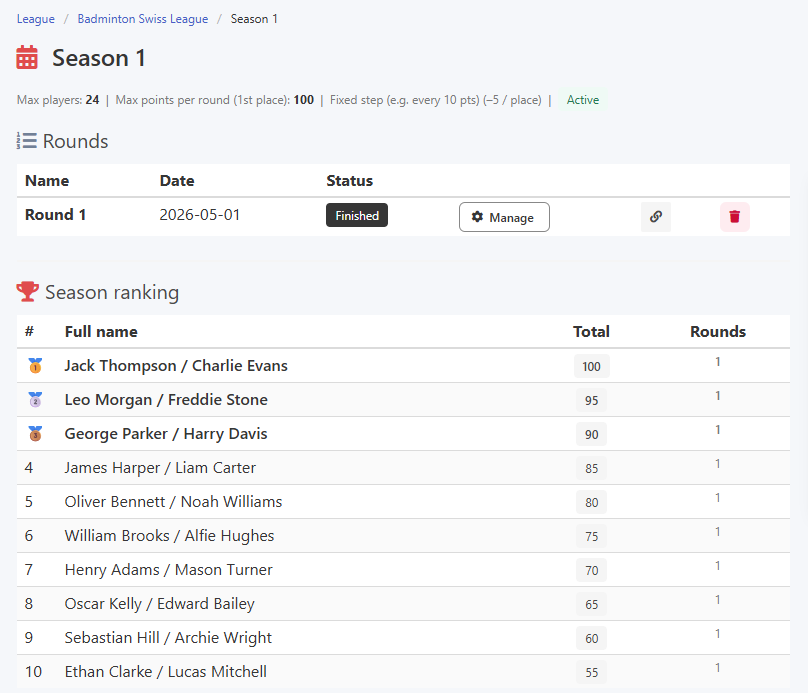
Fixed decrement: the same number of points is subtracted for each position drop. With 100 points for first place and a 5-point step: 1st place 100 pts, 2nd place 95 pts, 3rd place 90 pts, and so on.
Proportional: the step is calculated based on the number of participants. With 100 points and 10 players, 10 points are deducted per position: 1st place 100 pts, 2nd place 90 pts, 3rd place 80 pts, etc.
Progressive: the gaps between positions are uneven and increase toward the middle of the pack. Top positions are more clearly separated, for example: 1st place 100 pts, 2nd place 80 pts, 3rd place 60 pts, 4th place 50 pts.
Which method to choose depends on the nature of your competition. In recreational leagues, the proportional or fixed-step method tends to work well. The progressive variant rewards the podium more clearly and can be a better fit in more competitive settings.
Ranking system